GEM in everyday spaces

Wireless switching in practice

See where the switch goes, where the receiver goes, and which kit brings it together. Three ways to make lighting work around the space.

01 / Bedroom

Lights out. Without getting out of bed.

Add two-way control so you can switch the bedroom lights from the bed or the door.

2-way ยท with existing switch
Bedroom example: a new wireless switch beside the bed and a cutaway showing the receiver behind the original switch by the door.
Illustrative example

The job

The room has a light switch by the door, but nothing within reach of the bed. Running another switch cable would mean disturbing the finished room.

The solution

A surface mount wireless switch adds control beside the bed. The receiver sits at the original switch location, giving you two-way control: either the existing wired switch or the new bedside switch can turn the same lights on or off.

  • New wireless switch beside the bed
  • Receiver at the original door switch
  • Both control points operate the same lights
Connection diagram2-way switching with an existing switchView diagramHide diagram

The existing wired switch and the wireless switch both control the light circuit.

2-way switching with an existing switch

Diagram shows the connection arrangement. Refer to the instructions and ratings supplied with your kit.
02 / Garden

Bring the garden lights within reach.

Switch the garden lights from indoors, even when there is no existing wall switch.

1-way ยท wireless only
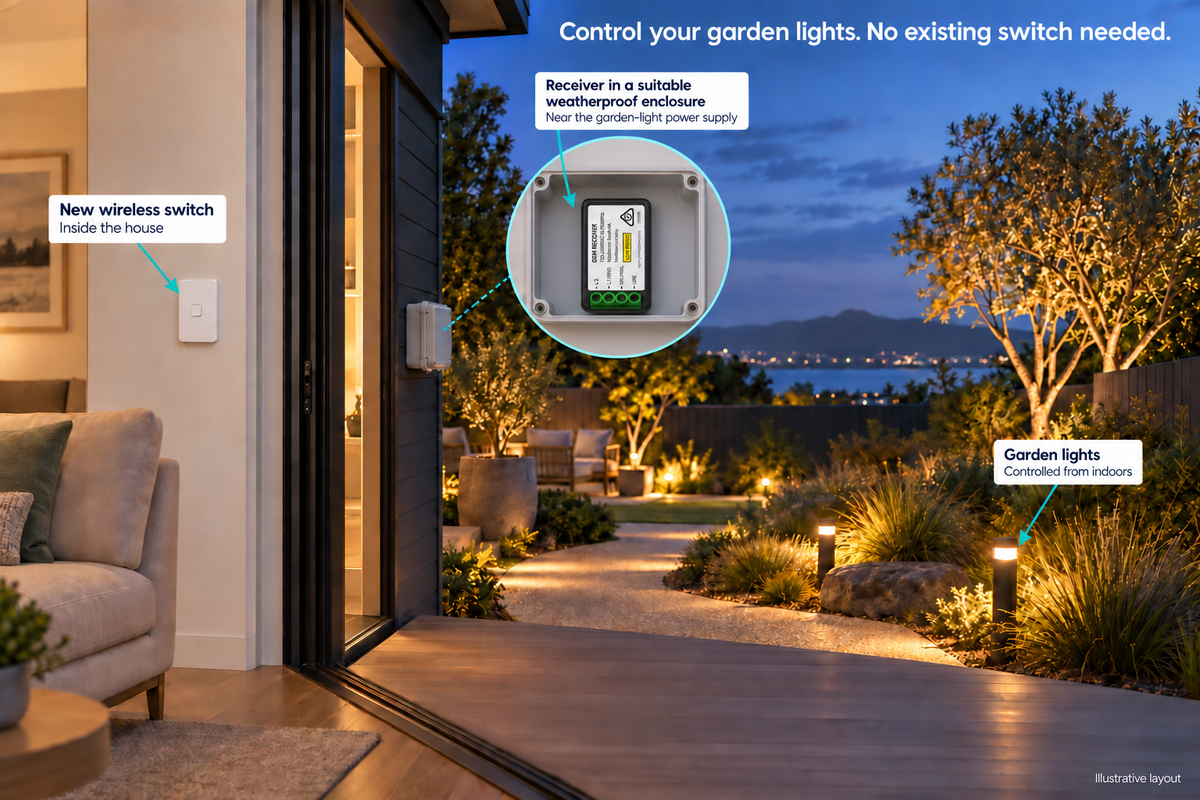
Garden example: a wireless switch inside the house controls garden lights through a receiver in a suitable weatherproof enclosure near their power supply.
Illustrative example

The job

Power is available for the garden lights, but there is no convenient switch inside the house to control them.

The solution

Place the wireless switch indoors where it is easy to reach. The receiver switches power to the garden lights from their supply location, housed in a suitable weatherproof enclosure for this outdoor example.

  • New wireless switch inside the house
  • Receiver near the garden-light supply
  • One wireless control point; no existing switch
Connection diagram1-way switching โ€” wireless onlyView diagramHide diagram

The standalone arrangement from our product page. The lights shown represent the controlled lighting circuit; garden-light power equipment depends on the fittings used.

1-way switching โ€” wireless only

Diagram shows the connection arrangement. Refer to the instructions and ratings supplied with your kit.
03 / Warehouse

Control two loads from one switch.

Operate two separate banks of warehouse lights together from a single wall switch.

1 transmitter ยท 2 receivers
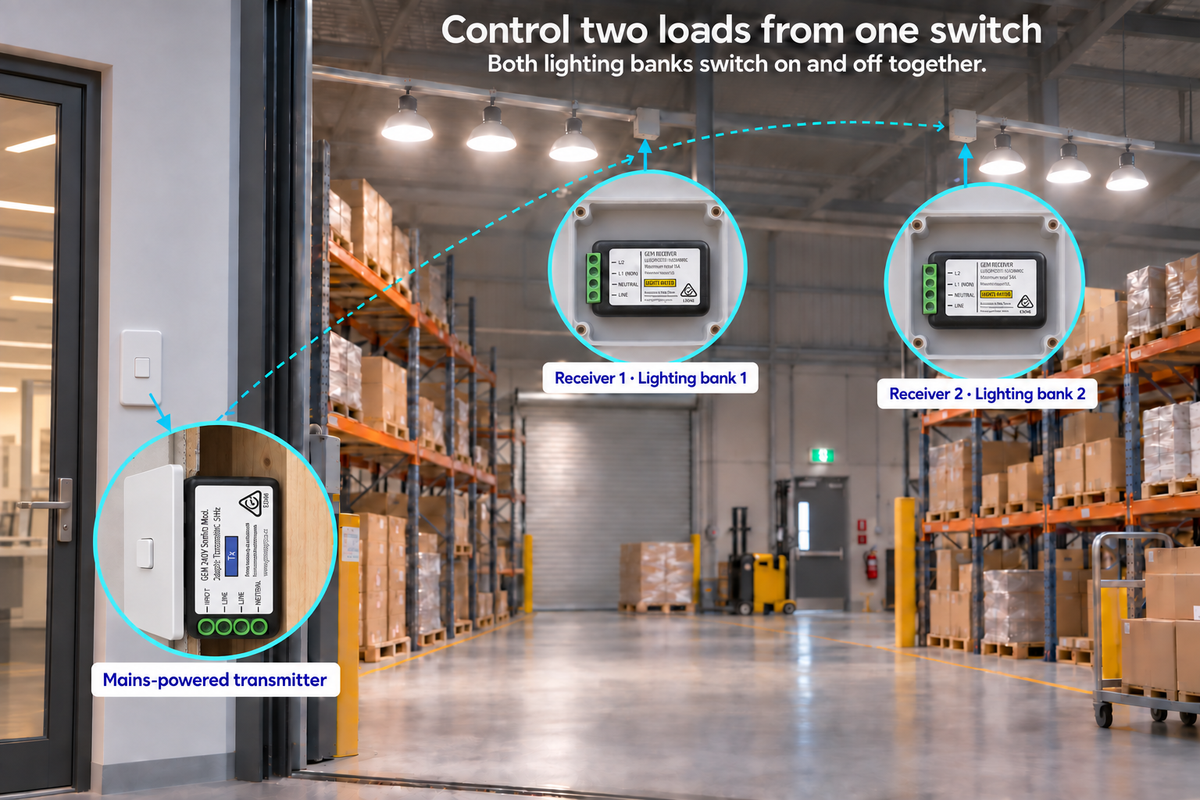
Warehouse with one mains-powered transmitter at a wall switch and two receivers, each controlling a separate illuminated bank of overhead lights.
Illustrative example

The job

Two banks of lights have power available, but there is no common switch cable back to the entrance. The customer wants one switch to turn both banks on and off together.

The solution

A conventional wall switch connects to the mains-powered transmitter. Both receivers are paired to that transmitter, with one receiver operating each lighting bank. Each receiver receives the wireless signal directly from the transmitter.

  • One mains-powered transmitter at the wall switch
  • One receiver for each lighting bank
  • Both banks switch on and off together
Connection diagram1 mains-powered transmitter with 2 receiversView diagramHide diagram

This original diagram shows one conventional switch connected to a mains-powered transmitter. Each receiver has a mains feed and switches its own lighting load.

1 mains-powered transmitter with 2 receivers

Diagram shows the connection arrangement. Refer to the instructions and ratings supplied with your kit.

Have a similar job in mind?

Tell us what you want to control and where you want the switch.

Talk to GEM